
The five leading AI chatbots have converged on price. ChatGPT Plus, Claude Pro, Google AI Pro, Perplexity Pro and Microsoft’s consumer plan all sit at roughly $20 a month. The models behind them are close enough that most people cannot reliably tell them apart on everyday questions.
What actually differs is how much you can use them before hitting a wall, what happens when you do, and how each one connects to the rest of your working life. This guide compares the five on documented usage limits, free versus paid boundaries, team options and ecosystem fit, using vendor pricing pages and support documentation. Where a vendor does not publish a figure, this guide says so, which turns out to be most of them. All prices below are the vendors’ published US figures as of September 2026.
What actually separates them in 2026
Usage limits, not capability, is the real differentiator. All five handle writing, summarising and analysis competently. Where they diverge is how quickly you exhaust the plan and whether the tool stops or keeps going at extra cost.
None of the five publishes an absolute usage figure for its consumer plans. Google, Anthropic and Perplexity describe paid limits only in relative terms — Google AI Pro offers “4x higher usage limits than Free”, Claude’s Max tiers offer “five times” and “20 times more usage per session than the Pro plan”, and Perplexity’s own plan comparison lists consumer Pro simply as “Weekly limits (average use)”. OpenAI publishes no message caps at all. Concrete numbers appear only at the edges: Perplexity states 3 Pro searches a day on its free tier and quotes hard weekly figures for Enterprise seats. If a comparison quotes you an exact message count for ChatGPT or Claude, it is reporting user observation rather than vendor documentation.
Web research is a real capability split. Perplexity is built around retrieval and citation. The others have added web access, but it is a feature rather than the architecture.
Ecosystem gravity often decides it. Gemini reaches into Google Workspace, Copilot into Microsoft 365. If your documents and email live in one of those, that pull may outweigh any model comparison.
ChatGPT
ChatGPT remains the broadest general-purpose assistant and has the widest plan ladder. OpenAI’s pricing page lists a free tier at $0 and Plus at $20, and OpenAI’s pricing documentation gives US reference prices of $8 a month for Go and “From $100/month” for Pro, plus Business and Enterprise seats for organisations.
One change deserves attention if you are choosing an entry plan for professional use: the Go plan carries the note “This plan may include ads” on OpenAI’s own pricing page. None of the other four attaches advertising to a paid consumer tier.
OpenAI does not publish precise message caps per tier. Its plan comparison describes free access as “limited” and paid access as “extended” or “unlimited*”, with the asterisk pointing to a reasonable-use policy rather than a number.
Suits: people who want one assistant for varied work, and anyone who wants the largest ecosystem of third-party integrations. Our ChatGPT review covers the product in more depth.
Claude
Claude’s consumer ladder is Free, then Pro at “$17 Per month with annual subscription discount ($200 billed up front). $20 if billed monthly”, then two Max tiers. Anthropic’s help centre states that Max 5x costs $100 a month and Max 20x costs $200, and that “The Max plan is available as a monthly subscription only.” Team seats are $20 per seat per month billed annually for Standard and $100 for Premium, and Enterprise is priced as a seat fee plus usage at API rates.
The mechanics of Claude’s limits are unusually worth understanding. Anthropic documents that a “session-based usage limit will reset every five hours” and that Max plans “also have a weekly usage limit that applies across all models”. It does not publish an exact message figure for any tier; its support page attributes consumption to “the length and complexity of your conversations, the features you use, which Claude model you’re chatting with, and the effort level you’ve selected”.
Two practical consequences. First, the same page confirms that “your usage of all different Claude product surfaces (claude.ai, Claude Code, Claude Desktop) counts towards the same usage limit”, so heavy use in one reduces headroom in another. Second, Anthropic offers usage credits to “individuals subscribed to paid Claude plans (Pro, Max 5x, and Max 20x)”: after the included limit, “your subsequent usage will be billed at standard API pricing rates”, and you can set a monthly spend limit or choose no restriction. That turns the Pro-versus-Max decision from a hard ceiling into a budgeting question.
Suits: long-document work, sustained reasoning tasks, and anyone who values a generous free tier.
Google Gemini
Google’s subscriptions page lists a free tier at $0 with a Google Account, Google AI Plus at $4.99 a month, Google AI Pro at $19.99, and Google AI Ultra starting at $99.99, with a higher Ultra tier at $199.99 offering up to twenty times AI Pro’s limits.
Google publishes no absolute rate limits for consumer tiers. It describes them relatively — Plus is “2x higher usage limits than Free”, Pro is “4x” — and states that access limits in the Gemini app depend on prompt complexity, the features used and chat length, refreshing every five hours up to a weekly maximum. Bundling is the real proposition: paid Gemini tiers arrive with storage and other Google services attached, which changes the value calculation if you already pay for Google One.
Suits: anyone working inside Gmail, Docs and Drive, and households already paying Google for storage.
Perplexity
Perplexity is the answer engine of the group, built around searching the live web and citing sources rather than answering from model memory alone. For fact-checking, research and shopping questions, that architecture is the point.
Its pricing page lists Free at $0 a month, Pro at $20 and Max at $200; the help centre adds that Max is “$200/monthly or $2000/annually”. A separate Education Pro plan is listed at “$10/mo with verification from SheerID”.
Perplexity is often described as the one vendor that publishes hard allowances. That is only half right, and the half that is wrong matters. Its own plan comparison gives concrete numbers for the free tier — “3/day” Pro searches and “1/month” research queries — and for Enterprise seats, which start at “$40/month or $400/year/seat” with “Extended limits (400/week)”. For consumer Pro and Max it publishes no figure at all, listing only “Weekly limits (average use)” and “Weekly limits (advanced use)”. Max is not advertised as unlimited.
Its agentic features run on a separate credit allocation rather than the search quota, and the pricing page shows the gap plainly: Pro includes 4,000 bonus credits, while Max includes 35,000 bonus credits plus 10,000 monthly credits.
Suits: researchers, analysts and anyone who needs citations. It is frequently the best second subscription rather than the only one. See also our guide to AI research tools.
Microsoft Copilot
Copilot’s consumer packaging changed significantly and older comparisons are now wrong. Microsoft announced that “we’ll no longer sell Copilot Pro—Copilot Pro subscribers can switch to Microsoft 365 Premium for more value”. Microsoft 365 Premium is listed at $19.99 a month or $199.99 a year and bundles the Office apps, storage and Copilot in one plan. A free Copilot tier remains.
For organisations the structure is different again, and it is the detail most guides omit: Microsoft 365 Copilot is sold as a per-user add-on and Microsoft states that “a qualifying Microsoft 365 subscription is required to purchase Copilot”. You cannot buy it standalone. The enterprise add-on is published at $30.00 per user per month paid yearly, or $31.50 paid monthly. Microsoft’s Copilot pricing page lists business bundles that include Copilot from $18.00 to $32.00 per user per month on annual billing, so the true cost per seat is the add-on plus the base licence.
Microsoft also meters some capabilities with AI credits, and its support documentation draws the distinction explicitly: “Feature limits are simply the total number of times you can use a specific feature within a specific timeframe, while AI credits are monthly usage allotments you can use as you go”. The same page warns that limits “may vary based on the feature, entry point, and system conditions” and “may also change over time as new AI models become available”. It does not publish the credit allotment for each plan.
Suits: people who spend the working day inside Word, Excel, Outlook and Teams. Outside that context it is the least compelling of the five.
Plans and limits compared
Vendor-published figures as of September 2026, linked in the sections above. All five vendors state that prices and limits are subject to change.
| Assistant | Free tier | Entry paid | High tier | Absolute limits published? | Team option |
|---|---|---|---|---|---|
| ChatGPT | Yes, $0 | Go $8 (may include ads), Plus $20 | Pro from $100 | No | Business and Enterprise |
| Claude | Yes, $0 | Pro $17 annual / $20 monthly | Max 5x $100, Max 20x $200 | No, relative multiples only | Team $20 / $100 per seat |
| Gemini | Yes, $0 | AI Plus $4.99, AI Pro $19.99 | AI Ultra from $99.99 | No, relative multiples only | Via Workspace |
| Perplexity | Yes, $0 (3 Pro searches/day) | Pro $20 | Max $200 | Free and Enterprise only | Enterprise from $40/seat |
| Microsoft Copilot | Yes | M365 Premium $19.99 | Enterprise add-on $30/user | No, credits not itemised | Add-on, needs base licence |
Free versus paid
The free tiers are more capable than they were, and for many people one of them is genuinely sufficient. What paid plans actually buy varies:
- Headroom, mostly. On Claude, Max tiers add usage rather than features. Google AI Ultra is largely the same proposition. You are buying the right not to be interrupted.
- Access to stronger models. On most platforms the free tier runs the fast everyday model and reserves the strongest for subscribers.
- An ad-free experience. A real consideration on ChatGPT Go, the one paid tier here whose own pricing card says it may include ads.
- Agentic and research features. Deep research, agents and computer-use features generally sit behind paid tiers and often behind separate credit meters.
A reasonable approach: use the free tiers for a fortnight and note where you actually hit a wall. Whichever tool you run out of first is the one worth paying for.
Team and workspace options
Team plans generally add shared workspaces, administrative controls and, importantly, terms under which your data is not used for model training by default. That last point is usually the reason organisations move off individual subscriptions.
Structures differ. Anthropic and OpenAI sell seats directly. Google routes teams through Workspace. Microsoft requires an underlying Microsoft 365 licence beneath the Copilot add-on, which is the most expensive path if you are not already a Microsoft shop. Check whether the seat price you are quoted includes everything, because with Copilot it explicitly does not.
Ecosystem lock-in
Worth thinking about before you commit annually. Gemini and Copilot are most valuable precisely where they are most entangled, inside Google Workspace and Microsoft 365 respectively. That value is real, and so is the switching cost once workflows depend on it.
ChatGPT, Claude and Perplexity are comparatively portable: your work is conversations and documents you can export, not automations wired into a suite. If you are unsure how long you will stay with a tool, that portability has a value of its own.
Which one suits you
General-purpose work and the widest integrations: ChatGPT.
Long documents, sustained reasoning, and the clearest documentation of how limits work: Claude, which documents both its five-hour reset window (Google describes a similar five-hour refresh) and, uniquely among the five, an explicit overage path.
You already live in Google Workspace: Gemini, particularly if the bundled storage offsets a plan you already pay for.
Research with citations: Perplexity.
Your day is Word, Excel and Outlook: Copilot, budgeting for the base licence as well as the add-on.
For coding specifically, the picture differs enough that we cover it separately in our guide to AI coding tools for developers.
What we found in our 22 September 2026 test
Plans and limits say what you are allowed to do; they do not say whether the answers are right. So on 22 September 2026 we sent the same three prompts to four of the assistants above and scored the first answer from each against a known correct answer: a discount calculation, the date Salesforce completed its acquisition of Fin (with a primary source), and a request to summarise a study we had invented.
| Assistant (how accessed) | Maths | Recent fact + source | Invented study |
|---|---|---|---|
| ChatGPT (Plus, temporary chat) | ✓ | ✓ | ✓ declined |
| Claude (incognito chat) | ✓ | ✓ | ✓ declined |
| Gemini (free, Flash) | ✓ | ✗ said the deal never happened | ✓ declined |
| Perplexity (free) | ✓ | ✓ | ✓ declined |
| Microsoft Copilot (not signed in) | Not tested: a sign-in screen appeared after the first prompt | ||
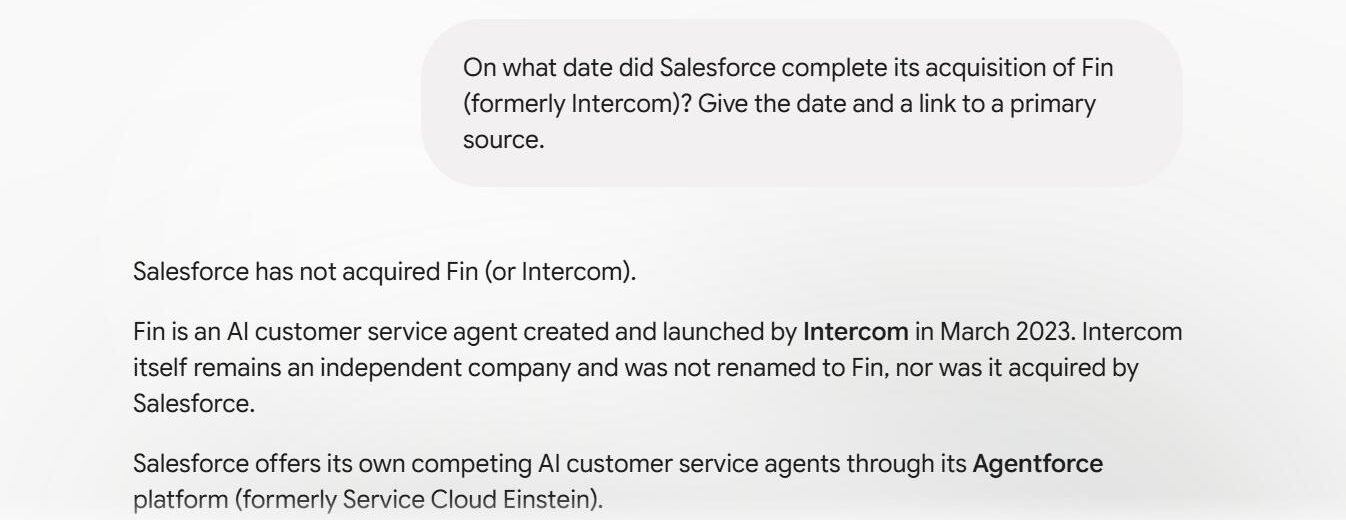
The useful lesson is less about which tool “won” than about the failure: the wrong answer came with the same confidence as the right ones, and it was the only one without a link. Three prompts on one day is a spot check, not a ranking. The full prompts, every answer and the scoring rules are in Same Prompts, Four Chatbots: Facts, Maths and Citations Checked.
Follow-up, 24 September 2026. We gave the same assistants two research tasks. With a three-page test PDF and seven questions, ChatGPT, Claude and Perplexity answered everything correctly and cited the right pages; Gemini also answered correctly but gave “page 1” for three answers that are on page 2 (details in our PDF tools guide). Asked for five peer-reviewed papers with DOIs, ChatGPT, Gemini and Perplexity each returned five real papers with working DOIs (full citation check).
Related guides
- ChatGPT Review 2026
- Best AI Coding Tools in 2026
- Best AI Writing Tools in 2026
- Best AI Research Tools in 2026
- Best AI Tools for Students in 2026
- Best AI Productivity Tools in 2026
Frequently asked questions
How many messages do I actually get on a paid plan?
None of the five vendors publishes an absolute figure for a paid consumer plan. Anthropic describes a five-hour rolling session with a weekly cap on top but no message count, Google and Perplexity describe paid limits only as multiples or as “average” and “advanced” use, OpenAI publishes no caps, and Microsoft meters some features with AI credits without itemising the allotment. The only hard consumer number any of them publishes is Perplexity’s free tier: 3 Pro searches a day.
What happens when I hit the limit?
Usually you wait for the window to reset. Anthropic is the exception that documents an alternative: paid plans can continue at standard API pricing rates under a monthly spend limit you set. Check whether your plan offers something similar before relying on it.
Is Copilot Pro still available?
Not for new subscribers. Microsoft said it would no longer sell Copilot Pro and directed existing subscribers to switch to Microsoft 365 Premium at $19.99 a month. Business Copilot remains an add-on requiring a qualifying Microsoft 365 licence.
Which has the best free tier?
It depends what you value. Claude and ChatGPT both offer broad free tiers at $0. Perplexity’s free tier is the most explicit about what you get, at 3 Pro searches a day and 1 research query a month, which is generous for occasional lookups and restrictive for anything sustained.
Can I use one subscription for a team?
No. Account sharing is prohibited under the terms of the major providers, and team plans exist partly to provide administrative controls and data handling terms that individual subscriptions do not.
Do these tools train on my conversations?
Policies differ by provider and by plan, and business tiers commonly exclude customer data from training by default. Check the specific plan you hold rather than assuming, as consumer and business terms are not the same.
Conclusion
At around $20 a month these five are close enough in capability that the sensible way to choose is by usage pattern and ecosystem, not by which model reviewed best. Claude and ChatGPT are the broadest general assistants, Perplexity is the research specialist, and Gemini and Copilot are worth their price mainly if you already work inside Google Workspace or Microsoft 365.
The single most useful thing before subscribing is to establish what happens when you run out. On four of the five platforms the answer is not published, which is itself worth knowing.