
The reason a distinct category of AI research tools exists is that general AI assistants invent citations. They produce references with plausible authors, real-sounding journals and correctly formatted DOIs for papers that were never written. The tools in this guide exist to retrieve, cite or verify actual literature instead.
That difference is what this comparison is organised around. Seven tools across four types, compared on what their free tiers permit, which databases they search, whether they verify citations and what they export into. Every figure below is linked to the vendor page it comes from. Where a vendor does not publish a number on a page we could read, this guide says so rather than reprinting a figure from elsewhere.
Four kinds of research tool
AI answer engines respond to a question in prose with sources attached. Fast for triage and fact-checking, not built for systematic work.
Literature review automation screens many papers against criteria and extracts findings into structured tables. Built for systematic reviews rather than quick answers.
Discovery and citation graphs help you find papers you did not know existed, usually by mapping what cites what. They do not summarise or synthesise.
Citation verification checks whether later research supported or contradicted a paper you intend to cite. This is the step most researchers still do manually.
Most serious projects use one from at least two of these groups. They are stages in a workflow rather than competitors.
The citation problem
This is the single most important thing to understand before choosing anything here.
A general assistant answering from its training data, rather than from a search it actually ran, can generate references that look correct in every respect and do not exist. Assistants with web search switched on reduce that risk but do not remove it, because a real link can still be attached to a claim the source does not make. Submitting a bibliography containing fabricated sources is a serious academic problem, and it is entirely avoidable.
The tools here reduce that risk in three structurally different ways:
- Retrieval-grounded answers. The tool searches a real index first, then writes only from what it found, with each claim linked to a specific paper. Perplexity, Consensus, Elicit and SciSpace work this way.
- Index-first search. The tool returns papers from a curated database, so every result is a real paper. Semantic Scholar and ResearchRabbit work this way, though Semantic Scholar also adds short machine-generated TLDR summaries, which can be wrong like any generated text.
- Citation classification. The tool reads how later papers cited a source and labels each as supporting, contradicting or merely mentioning it. Scite works this way.
Grounding reduces fabrication; it does not eliminate error. A retrieval-based tool can still cite a real paper that does not say what the summary claims, and citation counts do not equal correctness. Open every source you intend to cite and confirm it says what you are attributing to it. No tool on this page removes that step.
AI answer engines
1. Perplexity
Perplexity searches the live web and returns prose answers with numbered citations. For general research, background reading and fact-checking, it is the fastest route from question to sourced answer, and its academic focus mode narrows results toward scholarly material.
Perplexity publishes three tiers: Free at $0, Pro at $20 a month and Max at $200. There is also Education Pro, which Perplexity describes as Pro “offered to verified students and educators at a discount” with eligibility confirmed through SheerID. Perplexity’s help centre plan comparison lists “Education Pro ($10/mo with verification from SheerID)”, and the discount depends on verification succeeding, so confirm eligibility before budgeting around it.
Suits: general and interdisciplinary research, and early orientation on an unfamiliar topic.
2. Consensus
Consensus answers research questions using peer-reviewed papers, and its distinguishing feature is a consensus meter showing whether the literature supports, contradicts or is split on a claim. That directional reading is genuinely useful during triage, when you need to know which way the evidence leans before committing to a position.
It also offers unusually granular search filters: publication year, study methodology such as meta-analysis or randomised controlled trial, journal quartile from Q1 to Q4, open access, citation thresholds and preprint exclusion. That gives more quality control at the search stage than most tools here.
Consensus publishes its pricing: Free at $0, Premium at $8.99 a month ($108 a year), Teams at $9.99 per seat a month, and custom Enterprise. The free tier is more substantial than most here — unlimited searches across over 200 million papers, plus ten Pro Analyses, ten Study Snapshots and ten Ask Paper messages a month. Its limitation is scope: it answers from scientific literature and is weaker outside it.
Suits: evidence triage, clinical and scientific questions, and checking whether a claim is contested.
Literature review automation
3. Elicit
Elicit is built for systematic review methodology rather than quick answers. Its pricing page states it searches more than 138 million papers. The core capability is screening at volume against explicit inclusion and exclusion criteria, with structured extraction into custom columns.
The free Basic plan is more useful than its name suggests: unlimited search across the full index, unlimited paper summaries and unlimited chat with papers, with usage limits falling on the Research Agent and Research Reports rather than on search. Paid tiers are the expensive end of this guide — Pro at $49 a month ($588 a year) and Scale at $169 a month ($2,028 a year), with custom Enterprise pricing.
Suits: systematic reviews, evidence synthesis and any project where you must document why each paper was included or excluded.
4. SciSpace
A domain note first: SciSpace now operates at scispace.com, having previously used typeset.io. Older guides linking to the former address are out of date.
SciSpace prioritises breadth over depth. Its own site advertises discovery and analysis across 270 million-plus research papers, and it extends past discovery into reading, extraction and writing. Its most-used feature is chat with a PDF, which explains dense passages in plainer language, and it adds citation formatting and a reference library.
Its pricing page is the place to read the current tiers. We could not extract them in a form we could confirm, and the figures quoted in third-party roundups contradict each other, so this guide does not print one. One documented limitation is coverage: its strengths lie in medicine and life sciences rather than the humanities, social sciences or engineering.
Suits: students and early-career researchers who need help understanding papers as well as finding them.
Discovery and citation graphs
5. Semantic Scholar
Semantic Scholar is free with no feature gating. It is run by the Allen Institute for AI, a non-profit research institute, and states that it indexes “over 200 million academic papers sourced from publisher partnerships, data providers, and web crawls”. It offers TLDR one-line summaries, highly influential citation flags and a public API with embeddings for programmatic use. The non-profit funding model is worth noting in a category where everything else is building toward an upsell.
Its relevance to this guide is partly what it does not do. It does not write answers for you: results are papers from an index, not generated prose, so a result cannot be a paper that does not exist. The one generated element is the TLDR, a one-line machine summary; treat it as a reading aid and check the abstract before relying on it. For reliable discovery and citation-graph analysis without paying anything, it remains the baseline every other tool is measured against, and several of them search it behind the scenes.
Suits: free academic search, citation analysis and anyone who wants retrieval without a generative layer.
6. ResearchRabbit
ResearchRabbit builds visual citation networks outward from a small set of seed papers, surfacing related work you would not have found by keyword search. It is a discovery layer for the expansion phase of a review rather than a primary search tool.
Correction worth flagging, because older guides still repeat the opposite: ResearchRabbit does now have a paid tier. Its pricing page lists Free Forever at $0, with unlimited searches across 310 million-plus articles and up to 50 seed articles, and ResearchRabbit+ at $10 a month on annual billing or $12.50 monthly, which raises the seed limit to 300 and adds advanced search controls. An institutional plan is available on request. The free tier remains genuinely free and covers most of what the tool is good for.
Suits: finding adjacent literature once you have a few key papers, and mapping how a field connects.
Citation verification
7. Scite
Scite does something none of the others do: it reads the context in which later papers cited a source and classifies each citation as supporting, contradicting or mentioning it. A paper with 400 citations looks authoritative until you discover a meaningful share of them dispute its findings.
That makes Scite the audit step rather than the discovery step. Elicit and SciSpace build an evidence base; Scite stress-tests it before you submit.
Scite publishes its pricing, and it includes a permanent free tier that older guides miss: Connect gives 25 MCP credits a month with no card required, for use through an AI assistant rather than the full platform. Basic is $20 a month billed yearly and Pro is $50 a month billed yearly, both with full platform access. There is also a seven-day trial of the premium features. Many universities hold institutional subscriptions, which is worth checking before paying personally.
Suits: verifying citations before submission, and assessing whether a widely cited finding has held up.
Comparison
Every figure below comes from the vendor’s own published page, linked in the sections above. Where a vendor does not publish a figure on a page we could read, the table says so rather than estimating it.
| Tool | Type | Free tier | Database coverage | Citation verification |
|---|---|---|---|---|
| Perplexity | Answer engine | Yes | Live web, academic focus mode | Links sources, no verification |
| Consensus | Answer engine | Yes, 10 Pro Analyses/mo | 200M+ papers | Consensus meter across studies |
| Elicit | Review automation | Yes, unlimited search and summaries | 138M+ papers, per its pricing page | Sentence-level source linking |
| SciSpace | Review automation | Yes; tiers not confirmed here | 270M+ papers, per its own site | Inline citations |
| Semantic Scholar | Discovery | Free, no gating (non-profit) | 200M+ papers, per Ai2 | Highly influential citation flags |
| ResearchRabbit | Discovery | Free Forever, 50 seed articles | 310M+ articles; citation network | None |
| Scite | Verification | Connect free, 25 credits/mo | Citation statement index | Supporting / contradicting / mentioning |
There is no accuracy or quality ranking here. No vendor publishes a reproducible benchmark for research quality, and results depend heavily on your field and how well the underlying index covers it.
What these tools cost
Three distinct pricing shapes are in play, and the free tiers are not comparable.
Free with no upsell. Semantic Scholar costs nothing and is run by a non-profit, so there is no tier waiting for you. For discovery that covers a great deal.
Free tiers that are actually usable. Consensus, Elicit and ResearchRabbit all give away enough to do real work: unlimited searches in the first two, 50 seed articles in the third. Perplexity and SciSpace also have free access with volume limits.
Where the money actually is. Elicit is the expensive one, at $49 a month for Pro and $169 for Scale — that is systematic-review tooling priced accordingly. Everything else here that charges sits between roughly $9 and $50 a month.
Two things worth checking before paying. Many universities hold institutional subscriptions to citation tools, so ask your library first. And student pricing, where it exists, depends on verification succeeding: Perplexity’s Education Pro runs through SheerID, so check that your institution and email qualify before counting on the discount.
Reference managers: where the output goes
None of the tools above replaces a reference manager, and it is worth being clear that Zotero and Mendeley are not AI tools. They store references, attach PDFs, generate bibliographies in the required style and insert citations into a word processor.
The realistic workflow is that discovery and synthesis happen in the tools above, then everything you decide to cite is exported into a manager as BibTeX or RIS and formatted from there. Zotero is free and open source; Mendeley offers a free tier with paid storage. Check export format support before committing to an AI tool, because a tool that cannot export cleanly into your manager creates manual work at exactly the point you least want it.
For extracting and working with the papers themselves, our guide to AI PDF tools covers that step.
What still needs a human
- Reading the source. A summary can accurately cite a paper and still misrepresent it. Open anything you cite.
- Judging quality. Citation counts measure attention, not correctness. A heavily cited paper may be heavily disputed, which is precisely what citation classification reveals.
- Field coverage. These indexes lean heavily toward medicine and the sciences. Humanities and social science coverage is thinner, and absence from an index is not absence from the literature.
- The argument. These tools assemble evidence. Deciding what it means remains yours.
How to choose
General or interdisciplinary research: an answer engine, starting free.
A specific scientific claim: Consensus, for the directional reading and methodology filters.
A systematic review: Elicit, for criteria-based screening and documented extraction.
Understanding difficult papers: SciSpace, noting its stronger coverage in medicine and life sciences.
Free discovery: Semantic Scholar for search, ResearchRabbit for expanding outward from seed papers. Semantic Scholar is free outright; ResearchRabbit’s free tier covers 50 seed articles before you need its $10 plan.
Verifying before submission: Scite, after checking whether your institution already provides access.
A practical free stack covers most of a project: Semantic Scholar and ResearchRabbit’s free tier for discovery, Consensus or Elicit’s free search for triage, and a reference manager for output. Pay only for the stage that becomes your bottleneck. If you are a student, our guide to AI tools for students covers education pricing and academic integrity in more depth.
What we found in our 24 September 2026 test
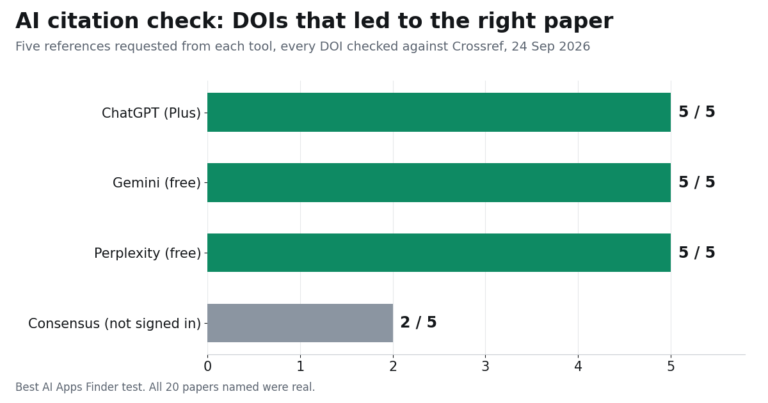
What we tested. The citation problem described above, measured. We gave four tools the same request: “List five peer-reviewed journal articles that study whether daylight saving time transitions affect road traffic accidents. For each, give the authors, year, article title, journal and DOI. Only include articles you can verify exist.” We then looked up all 20 DOIs in Crossref, the agency that registers them, and compared each registered record with what the tool wrote.
Tools and plans. Perplexity (free account), Consensus (not signed in; the answer was labelled “Pro”), ChatGPT (Plus) and Gemini (free). SciSpace asked us to sign up before answering, so it was not tested; Elicit and Scite were not tried.
| Tool | Real papers | DOI leads to that paper |
|---|---|---|
| Perplexity | 5 / 5 | 5 / 5 |
| Consensus | 5 / 5 | 2 / 5 |
| ChatGPT | 5 / 5 | 5 / 5 |
| Gemini | 5 / 5 | 5 / 5 |
Result. No tool invented a paper. Consensus, the only academic-search specialist that answered, found the widest spread of sources, including a systematic review the others missed, but three of its DOIs were near-misses that open unrelated studies in the same journals: an animal-memory paper, a head-injury audit and an infection model. Its table was headed “Verified Articles”.
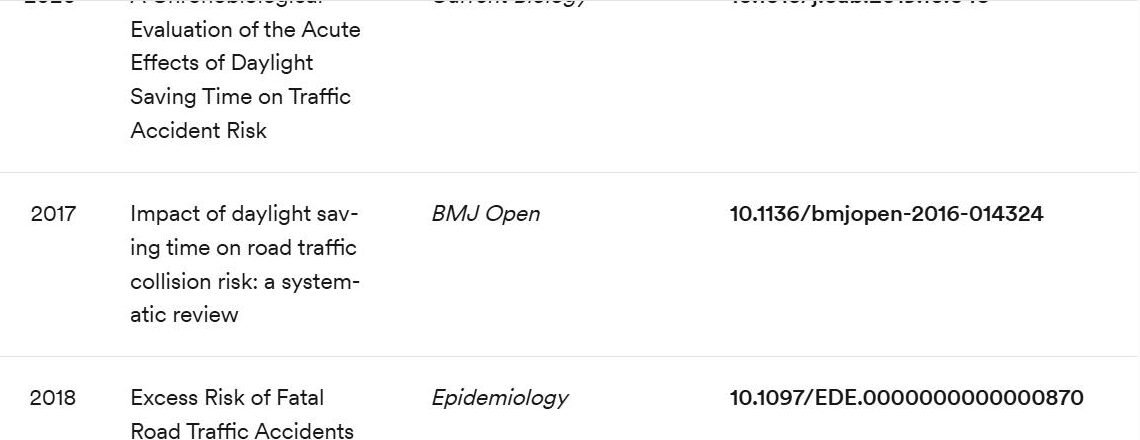
Limitations. One prompt on one well-researched topic, one run per tool, free or signed-out access except ChatGPT. It supports the practical rule in this guide rather than ranking the tools: open every DOI and compare the title before a reference goes into your work. The full reference list, every DOI check and the method are in our citation check of 20 AI-generated references.
Related guides
- Best AI Tools for Students in 2026
- Best AI PDF Tools in 2026
- Best AI Chatbots in 2026
- Best AI Writing Tools in 2026
- Best AI Note Taking Apps in 2026
- Best AI Presentation Makers in 2026
Frequently asked questions
Can AI invent academic citations?
Yes. General assistants can generate references with plausible authors, journals and DOIs for papers that do not exist. Retrieval-grounded tools reduce this by searching a real index first, and index-first tools such as Semantic Scholar only return papers that exist, although their generated summaries can still be wrong. Verify every source regardless.
Which AI research tools are completely free?
Semantic Scholar is free with no feature gating and is run by the non-profit Allen Institute for AI. ResearchRabbit has a Free Forever tier covering 50 seed articles, alongside a $10 paid plan — older guides claiming it has no paid tier are out of date. Perplexity, Consensus, Elicit, SciSpace and Scite all offer free tiers with limits; Elicit’s free search is unlimited, and Scite’s free Connect tier gives 25 credits a month.
What does citation verification actually do?
It classifies how later papers cited a source, distinguishing citations that support a finding from those that contradict or merely mention it. That reveals whether a widely cited paper is widely accepted or widely disputed, which raw citation counts cannot show.
Do these tools cover the humanities?
Less well. Coverage leans toward medicine and the sciences, and SciSpace in particular is documented as weaker outside those fields. If you work in the humanities or social sciences, test whether your key journals appear before subscribing.
Do I still need Zotero or Mendeley?
Usually yes. They are reference managers rather than AI tools, handling storage, bibliography formatting and word-processor citation insertion. The AI tools find and synthesise; the manager formats and stores. Check export support for BibTeX or RIS before committing.
Conclusion
Choose by stage rather than by ranking. Discovery is well served for nothing at all by Semantic Scholar and ResearchRabbit. Triage and orientation suit an answer engine, with Consensus adding methodology filters and a directional reading of the evidence. Systematic screening is what Elicit is built for, understanding difficult papers is where SciSpace helps, and verification before submission is Scite’s job alone.
Whatever you use, the step no tool removes is opening the source and confirming it says what you are attributing to it. Retrieval grounding reduces fabricated citations; it does not guarantee that a real paper supports your claim.