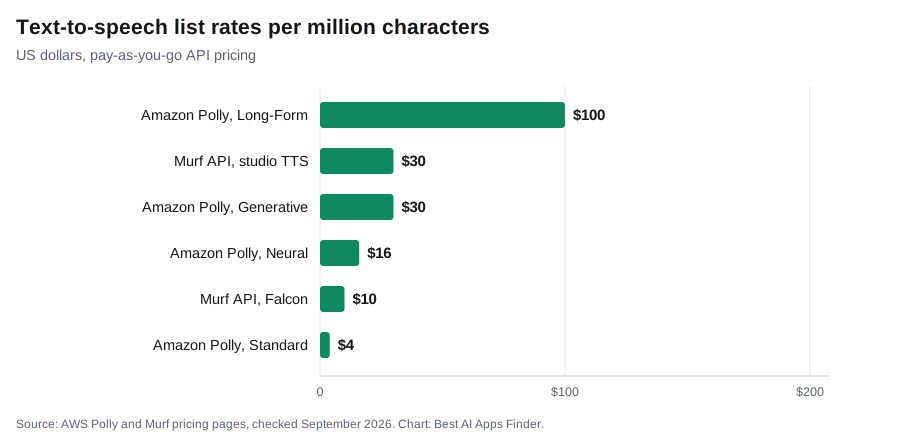
AI voice tools are compared on realism, but the number that decides your bill is characters. Consumer platforms sell a monthly character or credit allowance; cloud APIs bill per million characters, and the spread runs from $4 to $100 per million on Amazon’s rate card alone.
This guide covers text-to-speech: turning a written script into spoken narration using a ready-made or synthetic voice. Recreating a specific person’s voice from a sample is a different task, with its own tools and its own consent requirements — that is covered separately in our best AI voice cloning tools guide.
Six tools below in two groups, compared on what you actually get for free, what you pay beyond it, and whether the free tier permits commercial use. Every figure is linked to the page it came from.
Two kinds of tool
Consumer platforms give you a web editor, a voice library, a commercial licence and support. You paste a script and export audio. Pricing is a monthly subscription with an included allowance.
Cloud APIs give you an endpoint. There is no editor, no timeline and no review workflow — you build those. Pricing is pay-as-you-go per character with no subscription or minimum.
Cost per character is not directly comparable between the two, because one includes a product and the other includes infrastructure. Decide which you need first.
How characters convert to minutes, and why the answer varies
Every calculation in this guide rests on one conversion, and it is worth being precise about it because vendors are not.
A common rule of thumb is 1,000 characters per minute of speech. Amazon’s own pricing page uses a different figure: its worked examples put 1 million characters at roughly 23 hours 8 minutes, which works out at about 720 characters a minute.
Both are approximations. Actual duration shifts with speaking rate, punctuation, pauses and the model. The gap between the two is about 40%, which is enough to matter when you are sizing a plan — so where a vendor publishes its own conversion, this guide uses that one and says so.
What you are actually buying
Free tiers differ by orders of magnitude, and they differ in kind. ElevenLabs provides 10,000 credits a month. Azure provides 500,000 characters a month, listed with no expiry. Amazon Polly provides considerably more — but only temporarily, and its page is not entirely clear about which parts expire.
Paid rates diverge sharply by voice quality. Amazon’s pricing page lists Standard voices at $4.00, Neural at $16.00, Generative at $30.00 and Long-Form at $100.00 per million characters. That is a 25× spread inside one vendor’s rate card, before you compare vendors at all.
The most useful cost lever is caching. Amazon’s pricing page states that you can cache and replay generated speech at no additional cost. For anything with repeated phrases — phone menus, app prompts, recurring intros — storing and replaying the audio rather than regenerating it removes most of the cost.
A second lever is voice tier. Reserve premium voices for customer-facing narration and use standard voices for internal alerts and notifications, where the quality difference does not matter and the rate is a quarter.
Consumer platforms
1. ElevenLabs
ElevenLabs is the realism benchmark in this category, with a large voice library, emotional delivery, multilingual output and an API that scales from the same account.
Its free tier is 10,000 credits a month — roughly ten minutes of standard speech. The credit distinction matters: ElevenLabs runs one shared credit pool across every product it sells, so text-to-speech, dubbing, sound effects and transcription all draw on the same monthly allowance. On V2 Multilingual models one character costs one credit; Flash and Turbo models cost between half a credit and one credit per character on the API. Your allowance resets on your billing-cycle date, not on the first of the month.
Paid plans run Starter at $6 a month for 30,000 credits, Creator at $22 for 121,000, Pro at $99 for 600,000, Scale at $299 for 1,800,000 across three seats, and Business at $990 for 6,000,000 across ten. Enterprise is quoted.
Check the licence terms on your specific plan before publishing monetised audio — in this category, commercial rights are a plan feature rather than a given.
Suits: creators and studios where voice quality is the deciding factor and volume is moderate.
Not for you if: cost per character at volume is your driver. This is priced as a quality product, and the cloud APIs are an order of magnitude below it.
Affiliate link: ElevenLabs. We may earn a commission if you subscribe through it. The pricing figures above are cited from the official pricing page linked separately.
2. Murf
Murf is the team voiceover studio: a browser editor built for syncing narration to slides and video, with collaboration aimed at business and training content.
Murf now sells three things from one pricing page, on separate API, Studio and Dub tabs, so check which tab a quoted figure comes from. The API tab is the easiest to compare with the cloud services below, because it is priced per character: text-to-speech on its low-latency Falcon model at $0.01 per 1,000 characters ($10 per million), studio-quality text-to-speech at $0.03 per 1,000 ($30 per million), translation at $0.02 per 1,000 characters and voice changing at $0.10 per minute. The API trial includes “$10 FREE, every month”, and pay-as-you-go credit “never expires”. The Studio editor is sold as a separate subscription on its own tab.
Suits: business and e-learning teams producing narration collaboratively without code.
3. Speechify
Speechify approaches this from the reading side: converting articles, documents, PDFs and books into audio, with strong mobile apps and a large consumer following. Its Studio product covers production voiceover.
One thing to establish before comparing anything: Speechify sells two different products. The consumer reader and Speechify Studio are priced separately, and a figure quoted for one does not apply to the other. Check which product a price refers to before setting it beside anything else on this page.
For turning documents into audio specifically, our guide to AI PDF tools covers the reading side.
Suits: accessibility, studying and listening to written material rather than producing broadcast narration.
4. WellSaid Labs
WellSaid targets corporate e-learning and training, and its differentiator is provenance: voices built from consenting, compensated voice actors, which is why it appears on shortlists where a legal team is involved.
WellSaid now publishes its self-serve prices, and they are metered in download minutes rather than characters. Its pricing page lists a free Trial with “3 download minutes per month (no commercial rights)”; Starter at $10 a month billed annually ($120 a year, 240 minutes a year) or $19 monthly (20 minutes a month); Pro at $33 a month billed annually ($396 a year, 2,160 minutes a year) or $49 monthly (180 minutes a month); and Business at $160 per user a month billed annually, with 2,880 minutes per user a year and up to five seats. Enterprise is quoted. Every paid plan includes commercial rights.
Note the annual allowances: on Starter you receive a year’s minutes rather than a monthly refill, which suits uneven production schedules but means a heavy first quarter can empty the year.
Suits: enterprise learning and development teams needing consistent, ethically sourced narration at volume.
Not for you if: you need long-form narration cheaply; at 20 minutes a month, Starter is sized for short training modules.
Cloud APIs
5. Amazon Polly
Polly is the cost baseline for speech at scale. AWS’s pricing page states you are billed by characters converted, with Standard at $4.00, Neural at $16.00, Generative at $30.00 and Long-Form at $100.00 per million characters, and that cached speech can be replayed at no additional cost.
The free tier is more layered than most summaries admit. AWS publishes four separate monthly allowances — 5 million Standard characters, 1 million Neural, 500,000 Long-Form and 100,000 Generative — each applying independently.
The duration is where AWS’s own page is unclear. It attaches “for the first 12 months” to the Neural, Long-Form and Generative allowances, and attaches no duration to the Standard allowance. Separately, AWS’s Free Tier programme changed in July 2025: new customers receive up to $200 in credits, a free plan available for six months after account creation, and credits that expire twelve months from account creation. Three different timeframes appear on the same page. If free-tier duration matters to your plan, confirm it in your own account console rather than from any summary, including this one.
Two further details worth knowing. Speech Marks return timing metadata for synchronised highlighting or animation, which makes Polly more than a file generator — but Speech Marks are billed as characters too, so requesting both audio and marks for the same text bills twice. And prices are regional: AWS GovCloud (US) is billed at $4.80 for Standard and $19.20 for Neural per million characters, a 20% premium over the standard US rate.
It remains infrastructure: no editor, no editorial review, no distribution workflow. Those are yours to build.
Suits: applications needing predictable per-character costs, particularly with repeated audio that can be cached.
Not for you if: you need a browser editor, a review workflow or a voice library with a licence attached — or if you want a permanent free tier.
6. Azure AI Speech
Azure offers the widest language coverage of the major clouds and the deepest customisation, with precise SSML control and custom neural voice. It is the natural pick inside a Microsoft estate. Microsoft has folded the service under its Foundry Tools branding; the pricing page is now titled “Azure Speech in Foundry Tools”.
Its free tier (F0) is 500,000 neural text-to-speech characters a month. Azure’s pricing page lists this with no expiry attached, which — unlike Polly’s — makes it a durable option for genuinely low-volume use.
Paid rates are published in two bands, Neural and Neural HD, plus separate rates for Custom Voice. A note on reading Azure’s prices at all: Azure does not display figures until you select a region and currency, because the page loads them client-side. This guide therefore does not quote a base Neural rate. Read it yourself on the page, with your own region selected.
Two constraints that change the maths. Azure’s commitment tiers are fixed monthly spends, not volume discounts — the page lists three text-to-speech tiers at 80 million, 400 million and 2,000 million characters a month, each with a separate overage rate above the committed volume. There is no rollover.
More importantly, the commitment discount does not cover HD voices. Azure’s own footnote states that commitment-tier Neural pricing includes prebuilt non-HD, non-AOAI voices only: HD voices, AOAI voices, Custom Neural Voice and Personal Voice are excluded. If you commit at volume and then switch to HD for quality, you pay pay-as-you-go on top of a commitment you are already paying for.
Finally, provisioning is not immediate. Custom voice is a limited-access feature, and Personal Voice is restricted to pre-approved use cases requiring an application. Azure also carries the strongest compliance profile here.
Suits: Microsoft-aligned teams, multilingual applications and regulated environments.
Not for you if: you need something provisioned today, or you expect a commitment tier to cover your HD usage.
Comparison
Figures verified against each vendor’s official pricing page in September 2026 (Murf and WellSaid rechecked on 22 September). Where a cell says “see vendor page”, the vendor does not publish that figure in a form we can quote and verify. Subscription and pay-per-use costs are not directly comparable.
| Tool | Type | Free tier | Paid entry | Notes |
|---|---|---|---|---|
| ElevenLabs | Platform + API | 10,000 credits/mo, shared across all products | Starter $6 / 30,000 credits | Credits reset on billing date, not month start |
| Murf | Platform + API | API trial: $10 of usage a month | API from $0.01 per 1,000 chars (Falcon) | Studio subscription priced on a separate tab |
| Speechify | Platform + API | See vendor page | See vendor page | Two products priced separately |
| WellSaid Labs | Platform | 3 download minutes/mo, no commercial rights | Starter $10/mo annual (240 min/yr) | Metered in download minutes |
| Amazon Polly | API | 5M Standard, 1M Neural, 500K Long-Form, 100K Generative/mo | $4 / $16 / $30 / $100 per 1M | Free-tier duration stated inconsistently on AWS’s page |
| Azure AI Speech | API | 500K chars/mo, no expiry stated | Not published in fetchable form | Commitment tiers exclude HD voices |
There is no voice-quality column. No vendor publishes a reproducible measure of naturalness, and preference varies by language, accent and content type.
What 20 hours of narration a month actually costs
Twenty hours of finished audio is roughly 1,200 minutes. Converting that to characters is where the two rules of thumb diverge, so both are shown.
At AWS’s own conversion (~720 characters per minute): 1,200 × 720 ≈ 864,000 characters.
At the 1,000-per-minute rule of thumb: 1,200 × 1,000 = 1,200,000 characters.
| Engine | Rate per 1M | At 864,000 chars | At 1,200,000 chars |
|---|---|---|---|
| Standard | $4.00 | $3.46 | $4.80 |
| Neural | $16.00 | $13.82 | $19.20 |
| Generative | $30.00 | $25.92 | $36.00 |
| Long-Form | $100.00 | $86.40 | $120.00 |
Three things fall out of this.
Cloud API costs at this volume are trivial. Twenty hours of Neural narration is under $20 a month with no subscription. If a consumer platform costs more than that, you are paying for the editor, the voice library, the workflow and the licence — which may well be worth it, but you should know that is what you are buying.
The conversion rate matters more than it looks. The 40% gap between the two rules of thumb is a 40% gap in your bill. Before committing to a plan sized in characters, generate a representative sample and measure your own ratio.
The engine choice dominates everything else. Long-Form costs 25× Standard for the same text. Deciding which engine each piece of content actually needs will save more than any comparison of vendors.
Azure’s equivalent figures are not shown because its rates are not published in a fetchable form; run the same arithmetic against the rate you read for your region.
Commercial use and the free-tier trap
This catches monetising creators more than anything else in the category.
A free tier that lets you generate audio does not necessarily let you publish it commercially. Several platforms restrict free output to personal or evaluation use, and some attach fair-usage policies to plans advertised as unlimited.
Before publishing monetised audio, confirm three things in the terms for your plan: whether commercial use is granted at all, whether attribution is required, and whether the licence covers the specific voice you used, since some voices carry separate terms from the platform generally.
The cloud APIs are generally cleaner here, since usage is governed by the provider’s standard terms rather than per-voice licensing.
How to choose by volume
Occasional narration, a few minutes a month: a free tier covers it. Azure’s 500,000 monthly characters are listed without an expiry, which makes it the most durable free option here.
Regular content, no code: a consumer platform, budgeting for a paid plan because free tiers rarely include commercial rights.
High volume, developer available: a cloud API, using standard voices where quality does not matter and caching anything repeated.
Corporate training at scale: voice provenance and consistency matter more than per-character cost.
Audiobook-length projects: check the long-form rate specifically. At $100 per million characters on Polly, a full-length book costs considerably more than the standard rate implies.
For pairing narration with visuals, see our guides to AI video generators and AI subtitle generators.
Who should not use each of these
- Not ElevenLabs if your driver is cost per character at volume.
- Not Polly if you need an editor, a review workflow or a licensed voice library — it is an endpoint, not a product.
- Not Polly as a long-term free option. Most of its allowances are time-limited, so set an AWS budget alert before the free period ends.
- Not Azure if you need provisioning today, or if you expect a commitment tier to cover HD voices. It does not.
- Not any free tier for monetised output. Commercial rights are the paywall in this category, not audio quality.
What we found in our 22 September 2026 test
Because every cost figure in this guide depends on how many characters make a minute of audio, we measured it rather than rely on the rule of thumb.
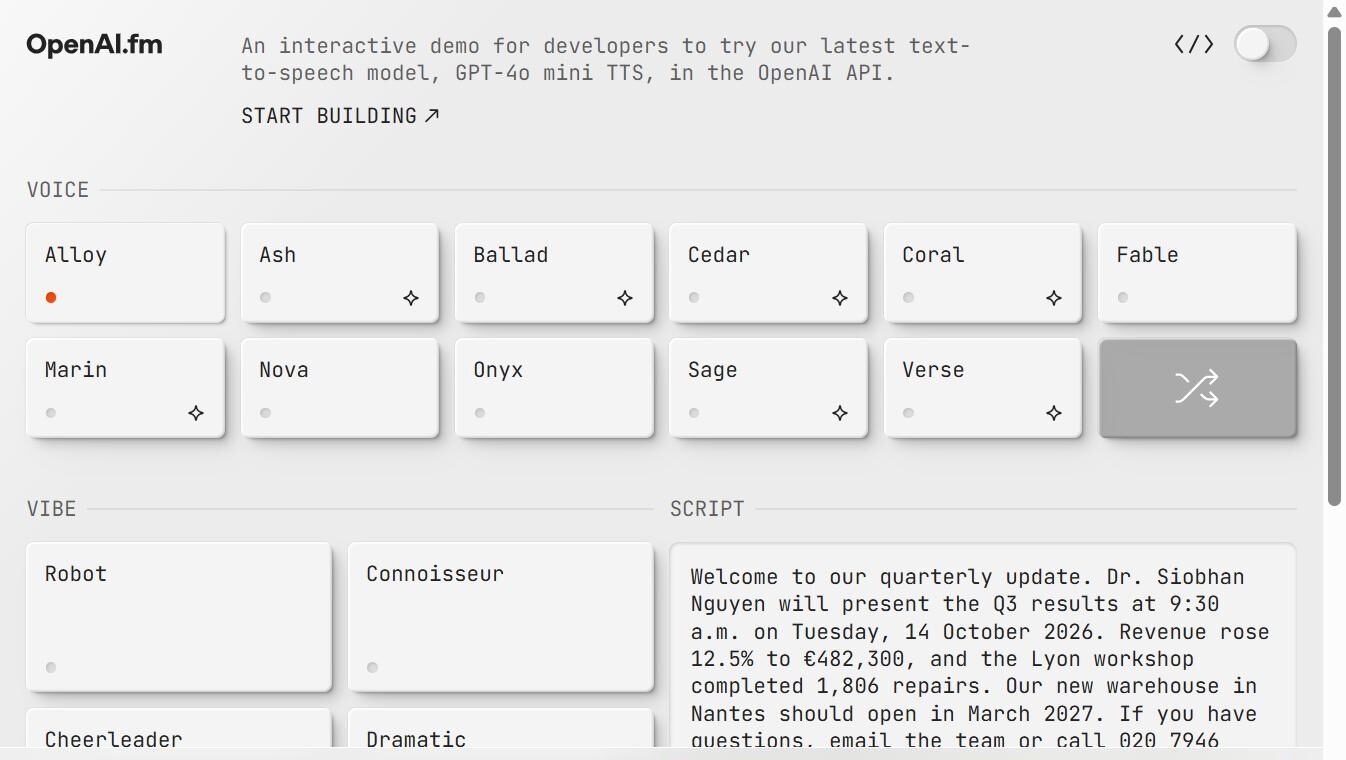
What we tested. One 381-character, 66-word script written to include the things narration has to handle: a title and surname (“Dr. Siobhan Nguyen”), a time, a full date, a percentage, a euro amount, a four-digit number and a phone number. The same script, with the same instruction (“clear, neutral narrator; calm and professional; natural, steady speaking pace”), was generated in three voices on OpenAI.fm, OpenAI’s free public demo of its gpt-4o-mini-tts model, on 22 September 2026. We measured each clip’s length from the audio file itself.
| Voice | Duration | Characters per minute | Words per minute |
|---|---|---|---|
| Alloy | 38.3 s | 598 | 104 |
| Onyx | 34.7 s | 660 | 114 |
| Nova | 29.1 s | 785 | 136 |
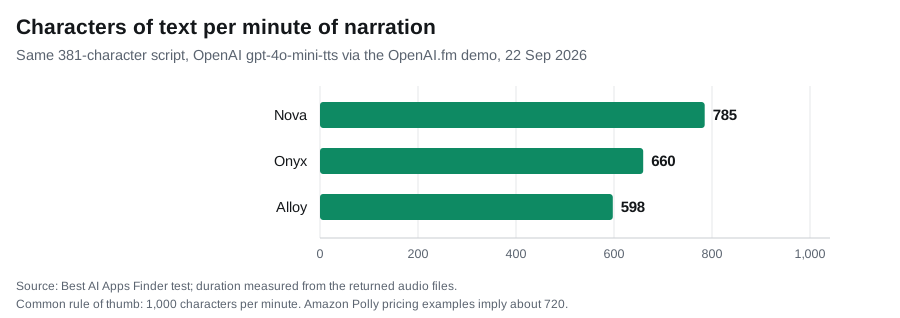
Result. None of the three voices reached the 1,000-characters-per-minute rule of thumb; all three were closer to the roughly 720 a minute implied by Amazon’s pricing examples. The choice of voice alone changed the length of the same script by 24%. Put another way, a 100,000-character allowance would have produced about 127 minutes of audio with Nova and about 167 minutes with Alloy at these rates, against 100 minutes by the rule of thumb. The rule is conservative, which is safe for budgeting, but it makes character-metered plans look worse value than they are and hides a real difference between voices.
What we could not test. We also tried ElevenLabs’ public text-to-speech demo with the same script. After we pressed “Generate speech” the page loaded a CAPTCHA service and produced no audio within 45 seconds; we do not complete CAPTCHAs, so ElevenLabs is not in the table. We also did not judge pronunciation: this measurement is about length, which is what plans bill for.
Limitations. One script, one model, three voices, one generation each. Speaking-rate instructions, punctuation and the model all move the figure, so measure your own script in your chosen voice before committing to a plan; the free tiers covered above are enough for that.
What we found in our 24 September 2026 follow-up: ElevenLabs’ free plan
ElevenLabs was missing from the measurement above because its public demo asked for a CAPTCHA. On 24 September 2026 we ran it from an existing free ElevenLabs account instead, which answers two questions the pricing page leaves open: what exactly is billed, and how much audio a credit buys.
What we tested. A 630-character, 108-word script we wrote for our subtitle test, containing a hyphenated surname and several numbers written out as words. Text to Speech, model Eleven Multilingual v2, voice “Josh – Teacher for Kids”, every slider left at its default (speed 1.0, stability 0.5, similarity 0.75, style 0).
Result.
- Billing: the balance fell from 10,000 to 9,370 credits, exactly 630: one credit per character, with spaces and punctuation counted.
- Length: the player showed 0:46, which works out at about 820 characters and 141 words a minute. The player rounds to the second, so treat the rate as roughly 810–830.
- What 10,000 free credits buys: at that rate, about 12 minutes of audio from this voice. ElevenLabs’ own plan comparison, shown inside the account, lists the free plan as “~10 min”, which assumes about 1,000 characters a minute.

What it means. The pattern matches the OpenAI measurement above: real narration runs below 1,000 characters a minute, so a character-metered allowance lasts somewhat longer than the rule of thumb suggests. The vendor’s own “~10 min” is a cautious estimate, not a guarantee in either direction; a faster voice or a slower one would move it.
Limitations. One voice, one model, one generation, and a different script from the OpenAI table, so the two sets of figures are comparable only as rates. The test says nothing about licensing: ElevenLabs’ public pricing page lists the commercial licence among the things Starter adds over Free.
Related guides
- Best AI Voice Cloning Tools in 2026
- Best AI Video Generators in 2026
- Best AI Subtitle Generators in 2026
- Best AI Music Generators in 2026
- Best AI Writing Tools in 2026
- Best AI PDF Tools in 2026
Frequently asked questions
How much text is a minute of audio?
It depends whose figure you use. A common rule of thumb is 1,000 characters a minute. Amazon’s own pricing examples work out at roughly 720. Both are approximations that shift with speaking rate and model, so measure a sample of your own content before sizing a plan.
Which free tier is most generous?
Amazon Polly’s 5 million Standard characters a month is the largest allowance, but AWS’s page attaches twelve-month limits to its other engines and the position on Standard is not clearly stated. Azure’s 500,000 characters a month is smaller and is listed without an expiry, which makes it better for ongoing low-volume use.
Can I use free-tier audio commercially?
Not always. Several platforms restrict free output to personal or evaluation use. Check the terms for your specific plan and voice before publishing monetised content.
Why do prices vary so much per million characters?
Engine tier. Amazon lists $4 for Standard, $16 for Neural, $30 for Generative and $100 for Long-Form — a 25× spread within one vendor. Using premium engines only where quality matters is the single largest saving available.
How do I reduce costs on repeated audio?
Cache it. Amazon’s pricing page states generated speech can be stored and replayed at no additional charge, which removes most of the cost for phone menus, app prompts and recurring intros.
Why can I not see Azure’s prices?
Azure loads its pricing figures after you select a region and currency, so they do not appear in a plain page fetch. Open the pricing page, set your own region, and read the rate there.
Conclusion
Decide first whether you need a product or an endpoint. A consumer platform includes an editor, a voice library and a commercial licence, and prices accordingly. A cloud API is cheaper per character by a wide margin and gives you nothing else.
Then work in characters rather than subscriptions — but measure your own conversion rate first, because the vendors do not agree on it. Two checks will save more money than any comparison of realism: use standard engines where quality is not the point, and cache anything you generate more than once.