
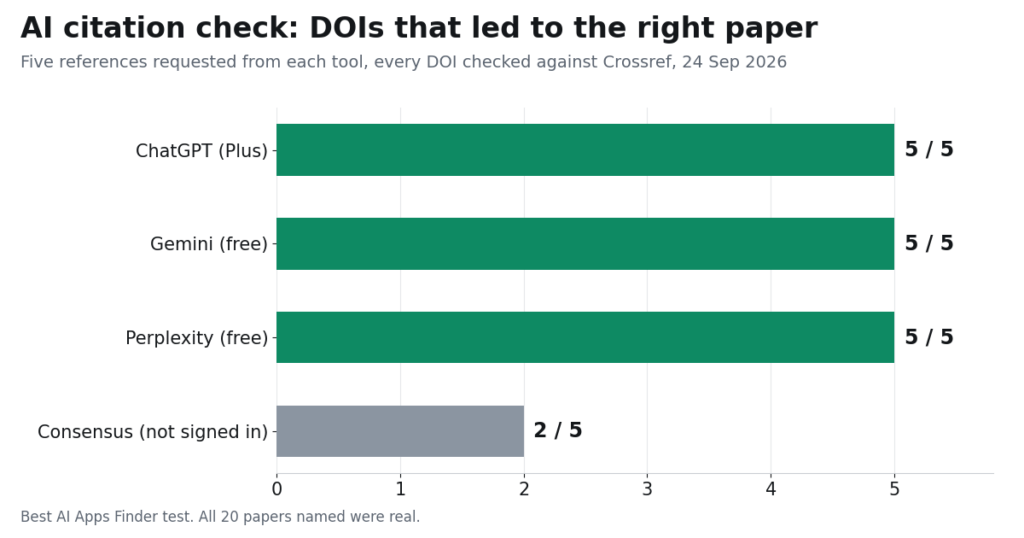
Ask an AI assistant for academic sources and you usually get a tidy list: authors, year, title, journal, DOI. What matters is whether each reference leads to the paper it describes. On 24 September 2026 we asked four tools for five peer-reviewed studies on the same topic, then checked all 20 references against each paper’s official DOI record.
The short answer: every paper named was real, and three tools got every DOI right. The fourth, Consensus, attached the wrong DOI to three of its five papers, and each of those DOIs opens a different, unrelated study. Its answer was headed “Verified Articles”.
How we ran the test
- Date: 24 September 2026, all four tools within about 20 minutes of each other.
- The prompt, pasted unchanged: “List five peer-reviewed journal articles that study whether daylight saving time transitions affect road traffic accidents. For each, give the authors, year, article title, journal and DOI. Only include articles you can verify exist.” We chose the topic because it has a real, well-indexed literature, so a tool that searches properly should find five genuine papers.
- Scoring: first answer only, no follow-up and no regeneration. For every reference we looked up the DOI in Crossref, the registration agency that records which publication each DOI belongs to, and compared the registered title, authors, year and journal with what the tool wrote.
- Who ran it: the prompts were entered in a web browser by our AI research assistant, Anthropic’s Claude, working under our instructions, as our Editorial Policy describes. Claude was not one of the tools scored in this test.
| Tool | How we accessed it |
|---|---|
| ChatGPT | Web, Plus account, temporary chat, default “Instant” model. It searched the web before answering. |
| Gemini | Web, signed-in free Google account, temporary chat, “Flash” model. The page showed a web-search step. |
| Perplexity | Web, signed-in free account, “Search” mode. The page showed that a free preview of its advanced search was active. |
| Consensus | Web, not signed in. The answer was labelled “Pro” and reported searching 370.8K results. |
| SciSpace | Not tested: typing the prompt opened a sign-up window. |
The results at a glance
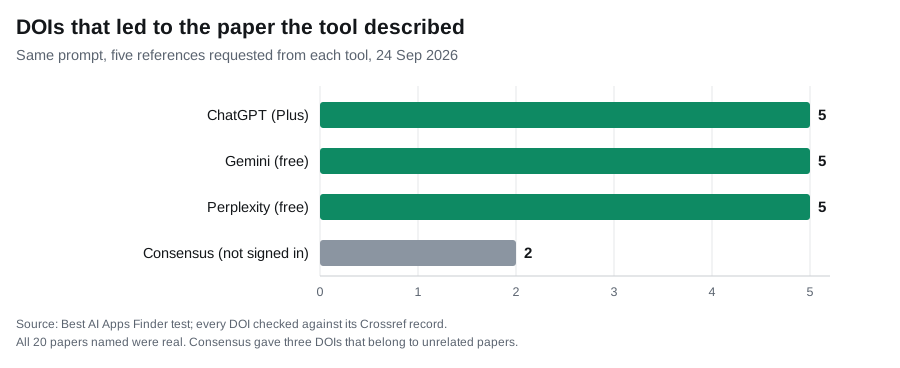
| Tool | Papers that exist | Title, authors, year and journal match | DOI leads to that paper |
|---|---|---|---|
| ChatGPT | 5 / 5 | 5 / 5 | 5 / 5 |
| Gemini | 5 / 5 | 5 / 5 | 5 / 5 |
| Perplexity | 5 / 5 | 5 / 5 | 5 / 5 |
| Consensus | 5 / 5 | 5 / 5 | 2 / 5 |
Every reference, checked
Between them the four tools named ten different papers. Only one, Lahti and colleagues’ 2010 Finnish study, appeared in all four lists.
| Paper (as registered) | Correct DOI | Given by |
|---|---|---|
| Lahti, Nysten, Haukka, Sulander & Partonen (2010), “Daylight Saving Time Transitions and Road Traffic Accidents”, Journal of Environmental and Public Health | 10.1155/2010/657167 | ChatGPT, Gemini, Perplexity, Consensus |
| Fritz, VoPham, Wright & Vetter (2020), “A Chronobiological Evaluation of the Acute Effects of Daylight Saving Time on Traffic Accident Risk”, Current Biology 30(4) | 10.1016/j.cub.2019.12.045 | ChatGPT, Gemini; Consensus with a wrong DOI |
| Smith (2016), “Spring Forward at Your Own Risk: Daylight Saving Time and Fatal Vehicle Crashes”, American Economic Journal: Applied Economics 8(2) | 10.1257/app.20140100 | ChatGPT, Perplexity, Consensus |
| Ferguson, Preusser, Lund, Zador & Ulmer (1995), “Daylight saving time and motor vehicle crashes: the reduction in pedestrian and vehicle occupant fatalities”, American Journal of Public Health 85(1) | 10.2105/AJPH.85.1.92 | ChatGPT, Gemini |
| Varughese & Allen (2001), “Fatal accidents following changes in daylight savings time: the American experience”, Sleep Medicine 2(1) | 10.1016/S1389-9457(00)00032-0 | Gemini, Perplexity |
| Coren (1996), “Daylight Savings Time and Traffic Accidents”, New England Journal of Medicine 334(14) | 10.1056/NEJM199604043341416 | Gemini, Perplexity |
| Meyerhoff (1978), “The influence of daylight saving time on motor vehicle fatal traffic accidents”, Accident Analysis & Prevention 10(3) | 10.1016/0001-4575(78)90012-X | ChatGPT |
| Laliotis, Moscelli & Monastiriotis (2023), “Summertime and the drivin’ is easy? Daylight saving time and vehicle accidents”, Health Economics 32(10) | 10.1002/hec.4715 | Perplexity |
| Carey & Sarma (2017), “Impact of daylight saving time on road traffic collision risk: a systematic review”, BMJ Open 7 | 10.1136/bmjopen-2016-014319 | Consensus, with a wrong DOI |
| Prats-Uribe, Tobías & Prieto-Alhambra (2018), “Excess Risk of Fatal Road Traffic Accidents on the Day of Daylight Saving Time Change”, Epidemiology 29 | 10.1097/EDE.0000000000000865 | Consensus, with a wrong DOI |
Consensus: right papers, wrong addresses
Consensus found five genuine, relevant papers, including a systematic review that none of the other tools listed. The problem was the DOI column. Three of its five DOIs differ from the correct one by a few characters, and each of them is a valid DOI that belongs to something else:
| Paper Consensus described | DOI it gave | What that DOI actually opens |
|---|---|---|
| Fritz et al. (2020), Current Biology | 10.1016/j.cub.2019.10.045 | “Episodic memory in nonhuman animals?”, Current Biology, 2019 |
| Carey & Sarma (2017), BMJ Open | 10.1136/bmjopen-2016-014324 | “AHEAD Study: an observational study of the management of anticoagulated patients who suffer head injury”, BMJ Open, 2017 |
| Prats-Uribe et al. (2018), Epidemiology | 10.1097/EDE.0000000000000870 | “Inferring Pathogen Type Interactions Using Cross-sectional Prevalence Data”, Epidemiology, 2018 |
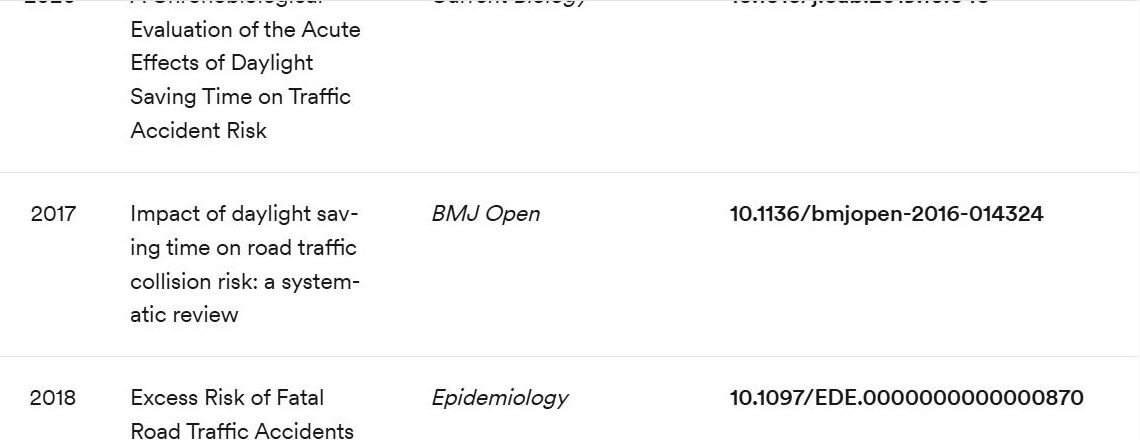
This is a nastier failure than an invented paper. A made-up title usually fails a quick search. A near-miss DOI in the same journal passes a glance and only fails when someone clicks it and reads the title that comes up. Anyone pasting these three references into a bibliography would be citing a study of animal memory, a head-injury audit and an infection model.
In fairness, the rest of Consensus’s answer held up where we checked it. It described Carey and Sarma’s review as covering 24 studies, and the review does report that 24 studies met its inclusion criteria.
What else we noticed
- Letters count as “articles”. Coren’s 1996 item in the New England Journal of Medicine is a letter to the journal. Perplexity called it a letter; Gemini listed it alongside full papers without saying so. It is a real, citable item, but if your assignment requires full research articles, check the article type.
- Citation counts without a source. Gemini added a “Cited by” number to each paper (for example 142 for the Fritz study) without saying where the count came from. Crossref’s own counts for the same five papers were lower in every case (93 for Fritz). Different databases count citations differently, so neither number is wrong in itself, but an unsourced count cannot be checked.
- An extra claim that checked out. ChatGPT recommended Carey and Sarma’s review and summarised it: of 16 short-term studies of the spring clock change, six reported more collisions, three fewer and seven no change. We checked this against the review’s full text and the figures are exact.
- “Verified” is a label, not a check. Our prompt asked each tool to include only articles it could verify. All four said, in one way or another, that they had. The only way we found the wrong DOIs was to look each one up.
How to check an AI reference list in five minutes
- Open every DOI. Put
https://doi.org/in front of it and open the link. Compare the title on the page with the title in your list, word for word. - If the DOI fails, search the title. Crossref’s free search or the journal’s own site will show the registered DOI for a real paper.
- Check the article type. Letters, editorials and conference abstracts are real but may not meet your requirements.
- Do not trust the formatting. Volume, issue and page numbers are easy to get right from a search snippet; the DOI string is where near-misses hide.
Limitations
One prompt, one topic, one run per tool, scored on the first answer. The topic has a well-indexed English-language literature, which is an easy case; niche fields, recent preprints and non-English sources are harder. We did not test paid plans of Gemini, Perplexity or Consensus, and a signed-in Consensus account or its “Deep” mode might behave differently. A tool that got five DOIs right here can still get the sixth wrong on another day.
For a buyer’s view of the same tools, including what each plan costs and which ones verify citations as a feature, see our guide to AI research tools. Our earlier same-prompts chatbot test checked a calculation, a recent fact and a made-up study, and our AI PDF tools guide reports how the same assistants handled a test PDF.